The Problem
Mission Aviation Fellowship flies pilots into places with no roads, reaching remote communities only by air, often in genuinely dangerous conditions. The work is extraordinary and almost entirely invisible. Their supporters understood the organization abstractly; almost nobody had seen what the job actually looks like.
That is a content problem, not a fundraising problem. An organization whose value is hard to picture will always struggle to grow support, no matter how good the cause is. You cannot ask people to fund something they cannot see.
What I Owned
This was not a production assignment. It was a business I ran from a blank page to a P&L, and every stage belonged to me:
- Found the story. Built the relationship with the nonprofit, identified what was actually compelling in work they had never been able to explain, and shaped it into a film.
- Raised the money. Developed the funding angle and secured every dollar of the roughly $250,000 budget. No studio backstop.
- Built the go-to-market. Designed the release strategy around an event, not a launch. That was the mechanic that made the economics work.
- Owned distribution. Negotiated directly with Fathom Events for a nationwide theatrical run, and handled the technical delivery to cinemas myself: DCP mastering, encoding, and spec compliance for hundreds of screens.
- Ran production, cradle to grave. Multiple countries including Alaska and Papua, Indonesia, with all the logistics that implies: permits, crews, remote travel, and aircraft access in places with no infrastructure.
- Directed, produced, and edited the film itself.
Why Theatrical Was the Strategy
Putting a nonprofit film in cinemas is not vanity. It changes what the content is worth:
- A ticket is a commitment. An audience that travels to a theater is qualified in a way a social impression never is. These are the people most likely to give and to advocate.
- The event creates urgency. A limited run of two nights only converts passive interest into a decision with a deadline. That is a campaign mechanic, borrowed from film distribution.
- The format sets the standard. A cinema screen forgives nothing. Committing to theatrical forced a production quality that made the film credible in every downstream channel it later lived in.
- One asset, a long tail. After the theatrical window, the film became an evergreen asset for the organization, still streaming and still screening, instead of a campaign that expired.
The Craft Argument
The reason this belongs in a marketing portfolio rather than a film reel: the production standard was the strategy. Audiences discount content that looks like it was made to persuade them. The way past that is not better arguments. It is work good enough that the audience forgets it was commissioned.
That principle carries directly into technical B2B content, where the audience is expert, skeptical, and quick to dismiss anything that feels like it was produced to hit a number.
The Return
Start with what the box office does and does not mean. The film cleared roughly $300,000 in ticket sales across 400+ theaters in a single night. But theatrical waterfalls pay exhibitors and the distributor first, so that money is not the return. What it is, is proof of demand: tens of thousands of people chose to buy a ticket and give up an evening for a story about an organization most of them barely knew. Very little B2B or nonprofit content ever gets tested that honestly.
The return came in three forms, and they compound:
- $500,000+ in donations and pledges following the release, roughly 2:1 on a $250,000 content investment
- A fully funded Kodiak aircraft, an operational asset the organization now flies to do the work the film is about
- Sustained demand and an evergreen library. The film is still streaming, still screening, and still recruiting supporters years after release. The spend was one-time; the asset keeps working.
On Location


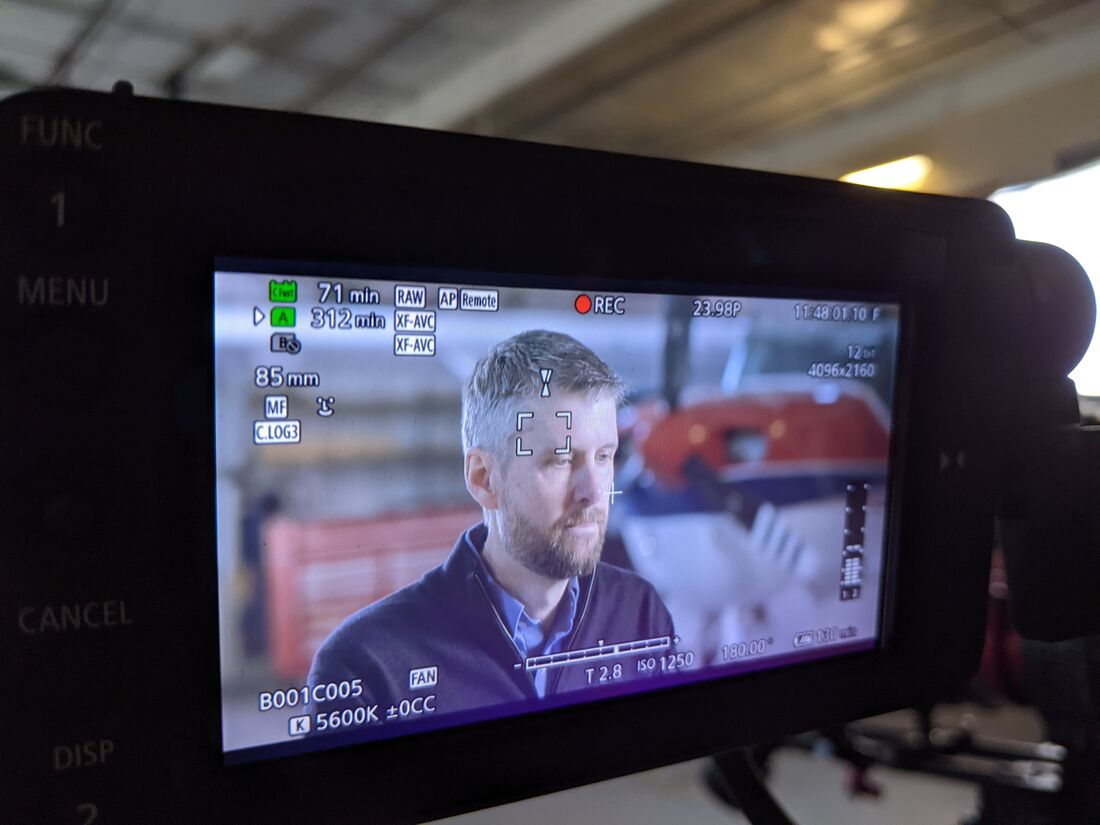


Production stills · MAF headquarters, Nampa, Idaho, March 2021
What This Demonstrates
Content marketing at its most demanding: a single asset carrying an organization's entire value proposition to an audience that had never seen the work, produced to a standard that let it compete for attention on commercial terms rather than charitable ones.
← All case studies